Application to Transmission Problems with Multiple Junctions
It is easy to define time-harmonic acoustic and electromagnetic
scattering problems
in piece-wise constant homogeneous media using a chunkgraph
object and a helper routine available in chunkie. This includes domains
with multiple junctions and an arbitrary nesting of regions defining
the dielectric media.
Suppose that the dielectric region consists of regions \(\Omega_{j}\),
\(j=2,\ldots n_{r}\), and
let \(\Omega_{1} = \mathbb{R}^{2} \setminus \cup_{j=2}^{n_{r}} \overline{\Omega_{j}}\)
denote the exterior region. Let \(\varepsilon_{j}\) denote the permittivity
and let \(k_{j}\) denote the wavenumber in \(\Omega_{j}\).
Let \(\Gamma_{\ell}\), \(\ell=1,2,\ldots n_{e}\)
denote the edges (possibly curved) in the chunkgraph, and let
\(r_{\ell,\pm}\) denote the index of the region numbers pointing in the positive
and negative normal direction to the edge respectively.
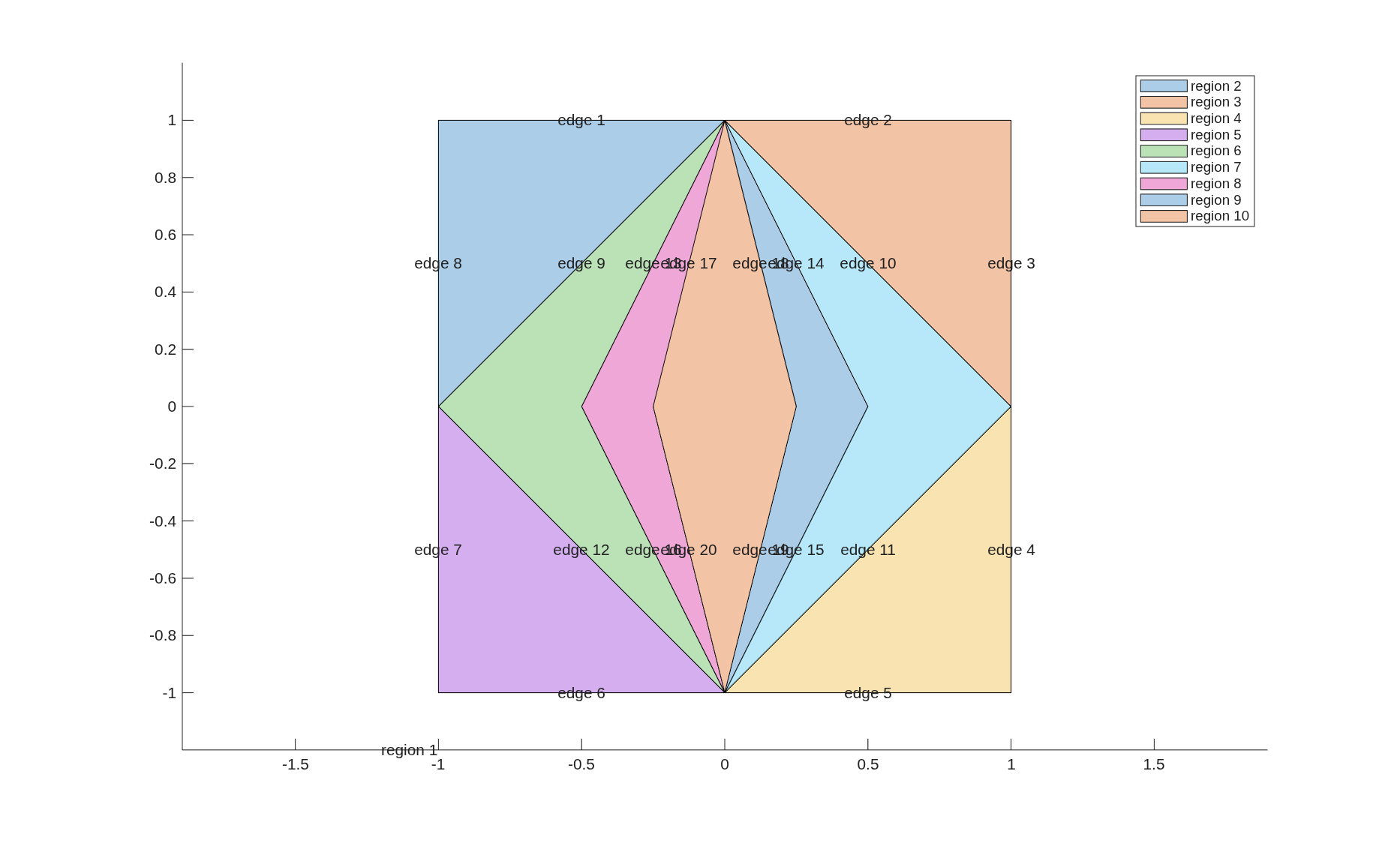
Consider the following domain consisting of \(9\)
dielectrics. We use the plot_regions
functionality of the chunkgraph to identify its regions and edges.
% define verts
verts_out = [[1;1],[1;-1],[-1;-1],[-1;1]];
verts_in = [[0;1],[1;0],[0;-1],[-1;0]];
verts_in2 = [[1/2;0],[-1/2;0]];
verts_in3 = verts_in2/2;

verts = [verts_out, verts_in, verts_in2, verts_in3];

% geometry will be a series of loops through subsets of vertices
id_vert_out = [5,1,6,2,7,3,8,4];
% call helper function
e2v_out = [id_vert_out;circshift(id_vert_out,1)];

id_vert_in = 5:8;
e2v_in = [id_vert_in;circshift(id_vert_in,1)];

id_vert_in2 = [5,9,7,10];
e2v_in2 =  [id_vert_in2;circshift(id_vert_in2,1)];

id_vert_in3 = [5,11,7,12];
e2v_in3 =  [id_vert_in3;circshift(id_vert_in3,1)];

% combine lists of edges
edge_2_verts = [e2v_out,e2v_in,e2v_in2,e2v_in3];

cparams = [];
cparams.maxchunklen = 4.0/max(zks);
cgrph = chunkgraph(verts,edge_2_verts,[],cparams);
figure(1);
clf
plot_regions(cgrph)
xlim([-2,2])
axis equal
For electromagnetic scattering, in the transverse electric or transverse magnetic mode, the potentials \(u_{j}\) in \(\Omega_{j}\), \(j=1,\ldots n_{r}\) satisfy the following transmission boundary value problem
Here \(\beta_{j} = 1\) for the transverse magnetic mode and \(\beta_{j} = 1/\varepsilon_{j}\) for the transverse electric mode.
A typical problem of interest is that of computing the scattered field from incident plane waves. In this case, the data \(f_{\ell} = -e^{-ik x\cdot d}\) and \(g_{\ell} = (d\cdot n)e^{-ik x \cdot d}\) are non-zero if and only if they are exposed to the unbounded region, i.e. one of \(r_{\ell,+}\) or \(r_{\ell,-}\) is \(1\), and \(d\) here is the direction of incidence of the plane wave.
Let \(G_{k}\) denote the Green’s function for the Helmholtz equation given by
Recall that the single and and double layer potentials are given by
where \(\Gamma = \cup_{\ell=1}^{n_{e}} \Gamma_{\ell}\).
The potentials \(u_{j}\) can then be defined in terms of the single and double layer potential operators as:
Then, imposing the boundary conditions on this representation results in the following equation for \(\sigma, \mu\):
for \(\ell=1,2,\ldots n_{e}\) where \(\gamma_{\ell} = \frac{2}{\beta_{r_{\ell,+}} + \beta_{r_{\ell,-}}}\).
Note
Note the single and double layer, and the integral equation
are appropriately scaled to ensure that the integral equation
is of the form \((I + K)\) as opposed to \(\alpha I + K\) for \(\alpha \neq 1\).
The current implementation of the corner compression scheme,
RCIP, requires this scaling for solving integral equations on
chunkgraphs. This restriction will soon be lifted in an upcoming release
of chunkIE, but is required as of the current version.
The chunkermat routine is capable of handling such a problem
specification, in which the interaction varies for different
pairs of chunkgraph edges. These interactions can be specified as
a \(n_{\textrm{edge}}\times n_{\textrm{edge}}\) matrix of kernel objects.
For transmission problems, we also provide a
helper routine, chnk.helm2d.transmission_helper, which
automates much of the process. This routine only requires the
chunkgraph, the wavenumbers \(k_{j}\), the coefficients \(\beta_{j}\)
and the regions abutting edges \(r_{\ell,\pm}\) which can be determined
using the chunkgraph routine, find_edge_regions.
Given this information, the routine returns
the kernels for solving the integral equation,
the boundary data for scattering from planewaves, and the
integral kernels needed to evaluate the solution in any region (for
postprocessing/plotting).
This simplifies the task of genertaing the system matrix quite a bit,
requiring only a few lines of code:
nreg = length(cgrph.regions);

% get region ids of interest programmatically, unbounded is always 1
ids = chunkgraphinregion(cgrph,[0 0.35 -0.35 0.5 -0.5 0.5 0.5 -0.5 -0.5; ...
                                0 0      0    0    0  0.6 -0.6 0.6  -0.6]);

% assign region wavenumbers
ks = zeros(nreg,1);
ks(1) = zks(1);
ks(ids(1)) = zks(5);
ks(ids(2:3)) = zks(4);
ks(ids(4:5)) = zks(3);
ks(ids(6:end)) = zks(2);

% jump condition coefficients
coefs = ones(1,nreg);


edge_regs = find_edge_regions(cgrph);
% set up parameters for planewave data
opts = [];
opts.bdry_data_type = 'pw';

% build system and get boundary data using the transmission helper
[kerns, bdry_data, kerns_eval] = chnk.helm2d.transmission_helper(cgrph, ...
                                   ks, edge_regs, coefs, opts);
% build system matrix
tic;
[sysmat] = chunkermat(cgrph, kerns);
sysmat = sysmat + eye(size(sysmat,2));
tbuild = toc
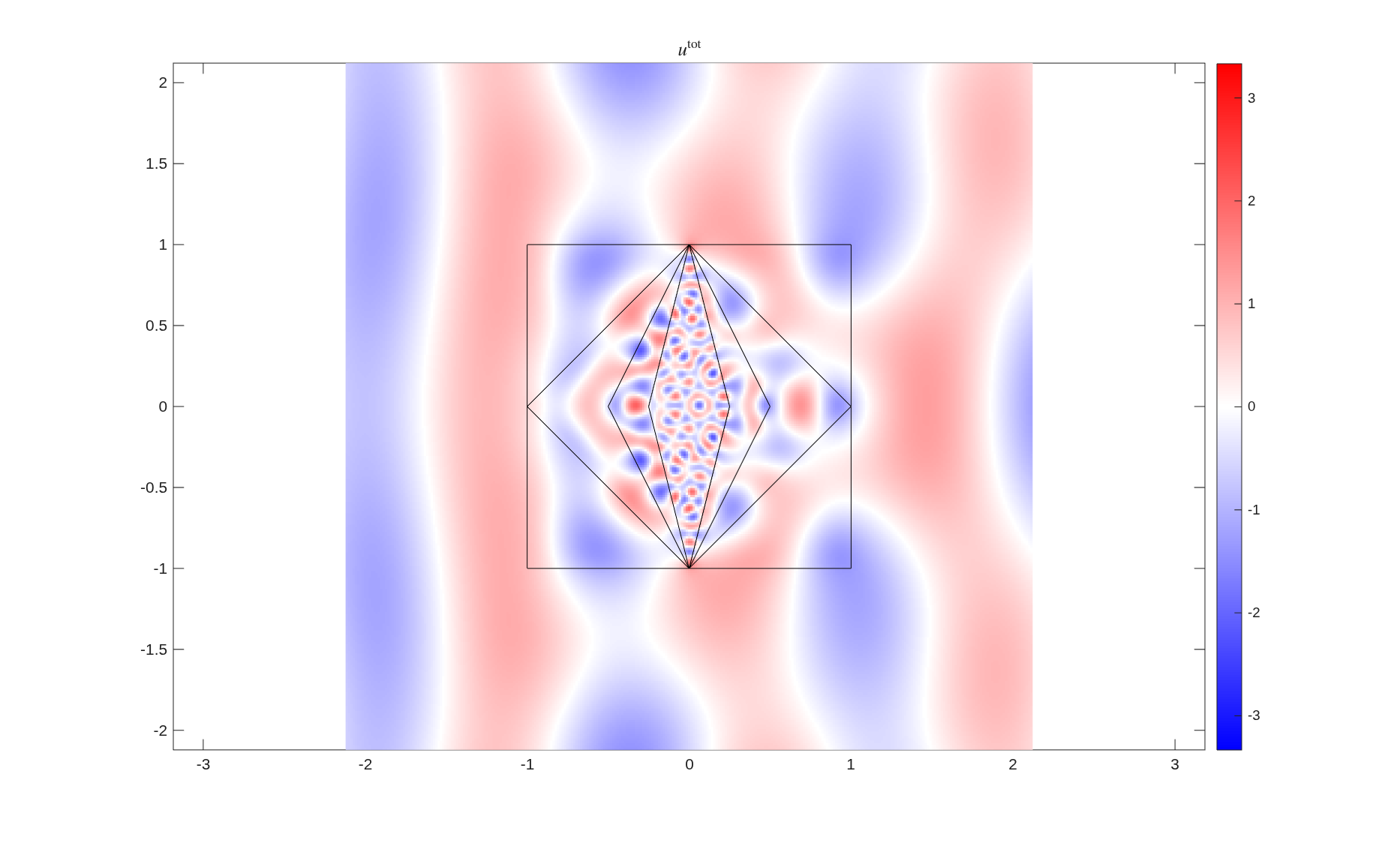
The solution can then be plotted in the bulk using chunkerkerneval
and the kerns_eval matrix of kernels:
L = 1.5*max(vecnorm(cgrph.r(:,:)));
x1 = linspace(-L,L,300);
[xx,yy] = meshgrid(x1,x1);
targs = [xx(:).'; yy(:).'];
ntargs = size(targs,2);

% evaluate potentials and return region labels
tic;
[uscat, targdomain] = chunkerkerneval(cgrph, kerns_eval, dens, targs);
uscat = reshape(uscat,size(xx));
tplot = toc

% identify points in computational domain
in = chunkerinterior(cgrph,{x1,x1});
out = ~in;

% get incoming solution
uin = zeros(size(xx));
uin(targdomain==1) = planewave([zks(1);0],targs(:,targdomain==1));

utot = uin + uscat;

umax = max(abs(utot(:)));
figure(2); clf
h = pcolor(xx,yy,imag(utot)); set(h,'EdgeColor','none'); colorbar
colormap(redblue); clim([-umax,umax]);
hold on
plot(cgrph,'k')
axis equal
title('$u^{\textrm{tot}}$','Interpreter','latex','FontSize',12)